
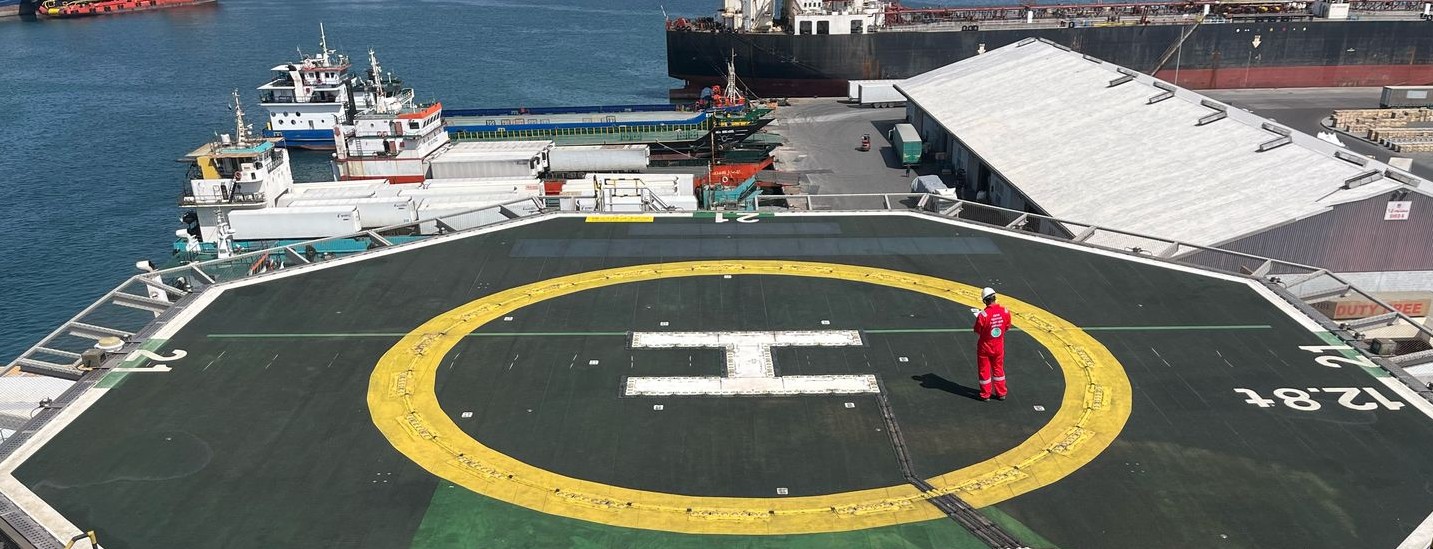
What happens during a helideck inspection?
Do you ever wonder how a helideck is being inspected? Or what does a helideck inspector actually check to ensure helicopters can land and take off safely? Then here’s everything you need to know about the helideck inspection process and the key areas that inspectors review to ensure safety and regulatory compliance.
Inspections are compliance checks that use checklists to verify that equipment or processes are safe and environmentally compliant. In our case, a Helideck Inspection is carried out by a qualified, experienced inspector to ensure the helideck meets local or international regulations, which allows helicopter operations to be conducted as safely as possible. A helideck inspection is the most effective way to assess operational safety and identify any non-compliance with applicable regulations or guidance. If the helideck meets the required standards, a Notice of Compliance or Certificate is issued. At OAS, inspections carried out by qualified inspectors aim to ensure full regulatory compliance, promote safety awareness among helideck personnel, and foster a strong safety culture in helicopter operations.
Ultimately, a helideck inspection should aim to improve safety and operations by driving positive change where necessary, rather than serving only as a tool to assess or mitigate the risk of non-compliance.
The applicable standards that provide the regulatory and operational guidance for helideck inspections include UK CAA CAP 437 (9th Edition, February 2023), Saudi Aramco Aviation Department Guidance, UAE GCAA CAR-HVD (Issue 1, March 2023), ADNOC Aviation Department Guidance, ICAO Annex 14 Volume II, ICAO Heliport Manual Doc 9261 Part I, OGP Guidelines for Aircraft Operations, and other global aviation industry and offshore best practices.
So, what really happens during a helideck inspection?
Following a prompt communication between the client and the helideck services provider regarding the inspection schedule and travel arrangements for an upcoming inspection, a nominated inspector is assigned to carry out the job. When a mobilization is initialized, the inspector conducts an opening meeting wherein he provides an overview of the inspection scope. The primary purpose of the opening meeting is to discuss the inspection plan and arrangements needed for the inspection. The areas to be inspected are as follows: 1) Radio Room/Bridge- the inspector reviews the radio equipment (both fixed and portable), the pitch/roll/heave systems, and the meteorological information equipment, and coordinates with the Radio Operator. 2) Passenger briefing and handling area- the inspector checks the working condition of equipment, records, scales, videos, and safety posters; and 3) The Helideck itself is the key area of the inspection. The inspector checks the markings, visual aids, and helideck lighting. All helideck lighting needs to be switched on and checked. The Inspector may be required to see the Fire Monitors in action to assess serviceability, flow rate, foam production, and sealed helideck. Other firefighting equipment also needs to be checked, as well as the contents of the crash box.
All activities within the job scope will be carried out in full compliance with applicable safety standards and regulations, including the use of PPE (Personal Protective Equipment). Upon completion of the inspection, the inspector will require a quiet room or office for approximately one hour to document any findings and prepare for the closing meeting. A closing meeting will be conducted in the same manner as the opening meeting held prior to the start of the job. During this meeting, the inspector explains all the important notices found or recommendations following the completed inspection.
Inspection reports shall be forwarded by the inspector to the client, along with the issuance of the
Approval (Notice of Compliance/Certificate)
if no Non-Compliances are identified during the inspection. In cases where a “High Priority” or “Other” Non-Compliance is identified, a
Temporary Approval (Notice of Compliance/Certificate)
will be issued instead.